
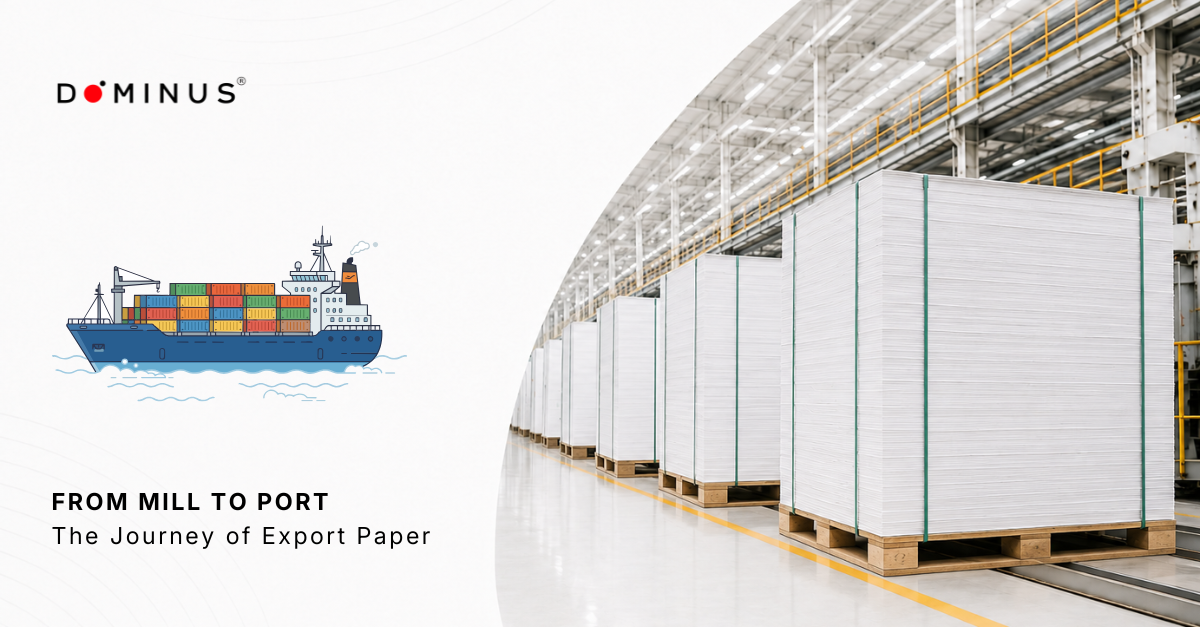
When an international buyer receives a container of paper, several important steps have already taken place before that container reaches the port.
For Dominus Paper, exporting paper is not simply about moving a product from India to another country. It involves careful attention to paper specifications, quality, converting, packing, documentation and logistics.
So, what actually happens to export paper before it leaves the paper mill?
1. Understanding the Paper Specification
Every export order starts with understanding the buyer’s requirements.
Depending on the paper grade, this can include:
- Paper grade
- GSM and caliper
- Reel or sheet size
- Reel width
- Moisture requirements
- Packing format
- Required quantity
- Application
For products such as Duplex Board and MF Recycled Kraft Paper, these specifications are important for ensuring the paper performs properly during the customer’s converting or manufacturing process.
2. Paper Production and Quality Checking
Once the specification is confirmed, the paper is produced at the paper mill through controlled manufacturing processes.
After production, the paper is checked according to the required specifications. Depending on the grade, checks can include GSM, caliper, moisture, appearance, surface quality and reel or sheet condition.
For international shipments, consistency is particularly important because the buyer may be using the paper regularly in their production.
3. Converting the Paper
Depending on the customer’s requirements, paper may be supplied in reels or sheets.
Reels require proper winding and dimensions, while sheeted paper requires accurate cutting and stacking.
The converting stage is therefore an important part of preparing paper for export.
4. Packing for International Transportation
Export paper can travel thousands of kilometres before reaching the customer’s warehouse.
It may be transported by truck to the port and then by vessel to the destination country. Proper packing helps protect the paper from handling damage, dust, moisture exposure and transportation-related issues.
Depending on the order, paper can be prepared in reel packing, pallet packing or bundle packing.
5. Container Loading
Paper is a heavy product, so container loading needs careful planning.
The paper must be positioned and secured properly to maintain load stability during transportation.
At Dominus Paper, container loading is treated as an important part of the export process — not simply the final step before dispatch.
6. From the Paper Mill to the Port
Once the paper is packed and the container is loaded, it travels by road to the designated port.
At the same time, export documentation is prepared and coordinated. Depending on the shipment, this may include the Commercial Invoice, Packing List, Shipping Bill, Bill of Lading and other required documents.
The physical shipment and its documentation must move together smoothly to avoid unnecessary delays.
7. The Paper Begins Its International Journey
After completing the required port procedures, the container is loaded onto the vessel and begins its journey to the customer’s country.
The complete process can be summarised simply:
Specification → Production → Quality Check → Converting → Packing → Container Loading → Transportation → Port → Ocean Shipment
How Dominus Paper Handles Paper Exports
At Dominus Paper, we understand that successful paper exports involve much more than supplying the right paper.
From Duplex Board to MF Recycled Kraft Paper, we focus on understanding customer specifications, preparing the paper appropriately, ensuring suitable export packing and coordinating the shipment process.
For an international paper buyer, reliability comes from every stage of the supply chain working together.
The journey of export paper doesn’t begin at the port. It begins at the paper mill.
